
A practical guide for UK temporary recruitment agencies
Already know what you need?
Skip the guide and explore the Sabre MS temporary recruitment software platform.
Temporary recruitment in the UK moves quickly. Short-notice bookings, changing client demand, worker availability, compliance checks, timesheets, payroll and invoicing all need to be handled without delay.
The wrong software choice can slow everything down.
Recruiters end up moving information between systems, chasing workers manually, checking documents outside the booking workflow, and spending too much time on admin instead of filling client requirements.
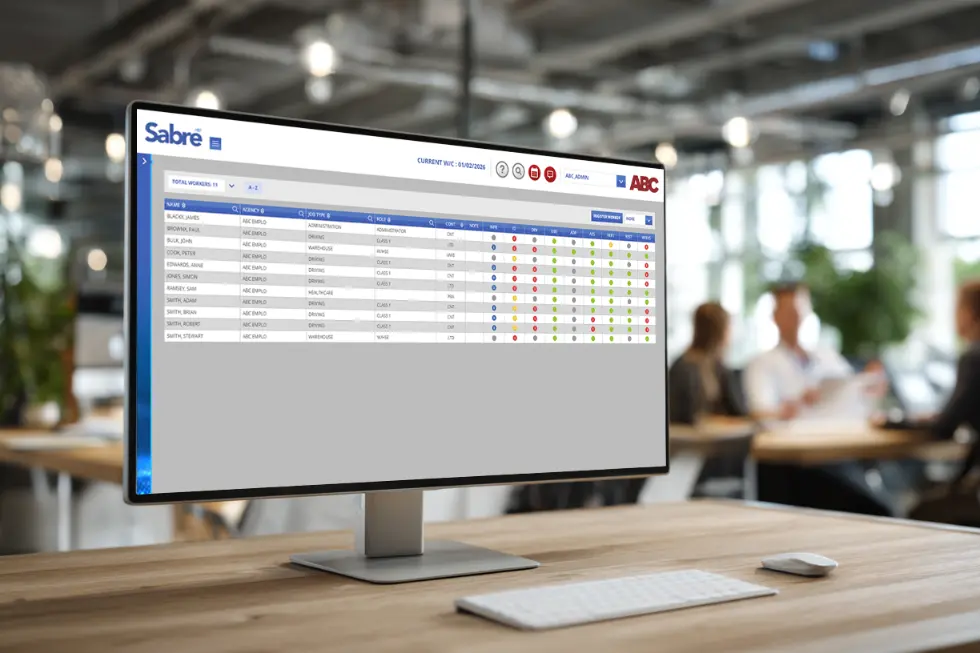
Not all temporary recruitment software is built for this kind of pressure.
Some platforms were originally designed for permanent recruitment and later adapted for temporary staffing. Others are built around different markets, with assumptions that do not always match UK recruitment workflows, compliance obligations or high-volume agency operations.
This guide covers seven features that matter when choosing temporary recruitment software for a UK agency. Use it as a practical checklist when comparing systems, asking questions in demos and deciding which platform will actually support the way your team works.
1) Simplicity and Intuitive User Experience
The best recruitment software is the software your team actually uses.
In temporary recruitment, complexity quickly becomes expensive. If consultants need weeks of training before they can confidently manage bookings, update records or process timesheets, the system is creating friction rather than removing it.
This matters even more in agencies with high staff turnover, multiple branches or busy desks where new team members need to become productive quickly.
Look for clear screens, logical workflows and visual prompts that help users understand what needs attention. A good system should make common tasks easier to complete, not bury them behind confusing menus.
Worker-facing tools should be just as simple. If temporary workers find registration, availability updates or shift information difficult to access from their phone, they may disengage before they are fully active on your books.
Questions to ask a vendor
- How long does it typically take a new recruiter to manage their first booking without support?
- Is the interface designed around temporary recruitment workflows?
- Can workers register, view shifts and update availability from their phone?
- How much training is needed before a team can use the system confidently?
2. High-volume efficiency through automation
Manual processes do not scale.
When your agency is handling large numbers of workers, bookings, documents, timesheets and client updates, every unnecessary manual task becomes a cost. It also increases the risk of delays, missed checks and duplicated data.
Temporary recruitment software should automate routine admin wherever possible, while still keeping recruiters in control of important decisions.
The automation features that matter most usually include:
- Digital candidate and worker registration
- Document collection and validation
- Compliance checks and expiry tracking
- Live booking management
- Shift allocation
- Worker notifications
- Timesheet processing
- Payroll and finance exports
The aim is not to remove the recruiter from the process. It is to remove repetitive admin so recruiters can focus on clients, workers and fulfilment.
Questions to ask a vendor
- Which parts of the registration-to-booking workflow are automated?
- Can the system reduce manual data entry between bookings, timesheets and finance?
- Are workers and clients automatically notified when relevant actions take place?
- Does automation support compliance, or does compliance still rely on manual checks?
3. Real-time operational visibility
Temporary recruiters make decisions quickly.
To do that properly, they need access to accurate, up-to-date information. If candidate availability, booking status, compliance, hours and financial data live in separate systems, your team is always working with an incomplete picture.
Real-time visibility helps agencies understand what is happening across the business without waiting for end-of-week reports or manual updates.
This is especially important when dealing with urgent client requests, high-volume shift fulfilment or multiple consultants working across the same accounts.
Good temporary recruitment software should help your team see:
- Worker availability
- Live bookings
- Booking changes
- Compliance status
- Timesheet progress
- Client activity
- Payroll and finance status
- Reporting and performance trends
The clearer the data, the faster your team can act.
Questions to ask a vendor
- Can recruiters see live booking and worker availability information in one place?
- How quickly does timesheet data appear in reporting?
- Can managers see operational and financial information without exporting spreadsheets?
- Are reports available as dashboards, graphs or exportable data files?
4. Built-in UK recruitment compliance
Compliance cannot sit outside the recruitment workflow.
In UK temporary recruitment, agencies need to manage checks such as Right to Work, AWR, GDPR, role-specific certifications and customer-specific requirements. If these checks are handled separately from bookings, they are easier to miss under pressure.
The right software should make compliance visible at the point where decisions are made.
That means recruiters should be able to see whether a worker is suitable before confirming a booking, not after the placement has already been made.
Look for software that supports:
- Worker document uploads
- Right to Work tracking
- AWR, DNI and GDPR checks
- Document expiry visibility
- Role or customer-specific requirements
- Suitability conflict alerts
- Compliance reports and exception views
- Audit-friendly records
Compliance should not feel like a bolt-on module. It should be part of the everyday workflow.
Questions to ask a vendor
- Can a non-compliant worker be placed into a booking?
- How are document expiry dates tracked?
- Can compliance requirements be tailored by customer or role?
- Does the system provide visual compliance reporting?
- Can managers quickly see exceptions that need attention?
- ?
5. Candidate and worker experience
Temporary workers often register with more than one agency.
That means experience matters.
If one agency makes it easy to register, view shifts, update availability and submit hours, while another relies on phone calls, screenshots and manual forms, workers will usually favour the easier option.
A poor worker experience does not just affect retention. It creates operational risk.
Missed updates, unclear shift information, slow communication and frustrating registration journeys can all lead to lower engagement and last-minute fulfilment issues.
Look for a mobile-first worker experience that supports:
- Digital registration
- Document uploads
- Shift visibility
- Assignment information
- Availability updates
- Hours and break entry
- Expense or mileage submission where needed
- Access to contracts, invoices or remittances
- Clear communication between worker and agency
The easier it is for workers to stay engaged, the easier it is for your agency to maintain a reliable temporary workforce.
Questions to ask a vendor
- What does the worker registration journey look like on a mobile phone?
- Can workers view planned shifts and assignment details?
- Can workers update availability themselves?
- Can workers submit hours, breaks, expenses or mileage through the app?
- How does the system reduce back-and-forth between workers and consultants?
6. Connected workflows across the recruitment lifecycle
Disconnected systems create duplicated work.
A separate CRM, a separate booking tool, a separate compliance tracker, a separate timesheet process and a separate finance system may work individually, but together they create gaps.
Every handover between systems is a chance for information to be lost, delayed or entered twice.
For temporary recruitment agencies, the strongest software connects the core workflow:
- Client and CRM management
- Worker registration and onboarding
- Compliance and document tracking
- Live bookings and shift allocation
- Timesheets and approvals
- Payroll, invoicing and finance
- Reports and management information
The test is simple.
Can your team move from a client requirement to a compliant booking, approved timesheet and raised invoice without fighting the system?
If the answer is no, the software may create more admin as your agency grows.
Questions to ask a vendor
- How many separate logins are needed to manage a full placement cycle?
- Does the platform include bookings, compliance, timesheets and finance?
- Can clients approve timesheets online?
- Can payroll and invoice data be exported from the same system?
- Does reporting pull from live operational data?
7. Transparent pricing and scalability
Temporary recruitment businesses operate on tight margins.
That makes pricing structure important.
Software that looks affordable at the start can become expensive if essential features, users, branches, support, training or setup are charged separately.
Before choosing a platform, make sure you understand what is included and what will cost extra later.
Look for clear pricing that reflects how your agency actually works. If your team needs to add more users, onboard another branch or involve third parties, the costs should be predictable.
Scalability also matters operationally.
As your agency grows, your software should be able to support more workers, more clients, more bookings and more reporting demands without forcing your team back into spreadsheets.
Questions to ask a vendor
- What is included in the base price?
- Are there extra charges for users, branches, support, training or setup?
- What happens to pricing as the agency grows?
- Is data migration included or charged separately?
- Can the system support multiple branches or larger temporary workforces?
What good temporary recruitment software should look like
The agencies that get the most value from their software usually make the same kind of decision.
They choose a platform built around temporary recruitment, not one adapted from permanent recruitment. They prioritise practical workflows over impressive feature lists. They make compliance part of the booking process, not a separate task. They choose systems that reduce admin rather than simply digitising the same old problems.
When comparing temporary recruitment software, use the seven areas in this guide as your scorecard:
- Is it simple enough for your team to use properly?
- Does it automate repetitive admin?
- Does it give you live operational visibility?
- Is UK compliance built into the workflow?
- Does it improve the worker experience?
- Does it connect the full recruitment lifecycle?
- Is the pricing clear and scalable?
A demo should show you how the system handles these areas in practice, not just what the dashboard looks like.
Why Choose Sabre MS for Your Agency?
Sabre MS has been developed for recruitment agencies managing high-volume, fast-moving temporary workforce operations.
The platform brings together worker registration, bookings, compliance, timesheets, finance and reporting, helping agencies reduce duplicated admin and work from a more connected view of their recruitment activity.
For UK agencies that need a system built around temporary recruitment workflows, Sabre MS is designed to support the full journey from worker application through to booking, approval, payroll and invoicing.
Explore the Sabre MS temporary recruitment software platform.
Or, if you are ready to see it in action, book a free demo and the team will walk through the workflow using examples relevant to your agency.
Evaluating your options?
This guide covers what to look for.
If you want to see how a platform designed for UK temporary recruitment handles these workflows in practice, Sabre MS is worth a look.
Frequently asked questions about temporary recruitment software
What is the most important feature in temporary recruitment software?
For most UK temporary recruitment agencies, the most important feature is the ability to balance speed with compliance. Agencies need to fill bookings quickly, but they also need confidence that every worker has the correct documents, checks and suitability requirements in place before they are assigned.
How does recruitment software help with UK compliance?
Good recruitment software helps by embedding compliance checks into everyday workflows. Instead of relying on recruiters to check separate spreadsheets or folders, the system can make document status, expiry dates and suitability information visible when bookings are being managed.
Can recruitment software improve worker retention?
Yes. Recruitment software can improve worker retention by making the agency easier to work with. Digital registration, mobile access to shift details, availability updates, clear communication and simple timesheet processes all help workers stay engaged with the agency.
Is cloud-based recruitment software suitable for temporary agencies?
Yes, provided the platform has appropriate security, access controls and data protection processes in place. Cloud-based recruitment software can be useful for agencies with multiple branches, remote consultants, client-site operations or workers accessing information from mobile devices.
Should temporary recruitment software include timesheets and finance?
For most temporary recruitment agencies, yes. Timesheets, approvals, payroll exports, invoicing and finance reporting are closely connected to bookings. When these processes sit in separate systems, agencies often face duplicated admin, delayed reporting and a greater risk of errors.
How do I compare temporary recruitment software providers?
Compare providers by asking them to walk through your real workflow. Start with worker registration, then move through compliance checks, client requirements, bookings, timesheets, approvals, payroll, invoicing and reporting. This will show whether the system is genuinely built for temporary recruitment or simply adapted from a more general recruitment platform.
For most UK temporary recruitment agencies, the most important feature is the ability to balance speed with compliance. Agencies need to fill bookings quickly, but they also need confidence that every worker has the correct documents, checks and suitability requirements in place before they are assigned.
Good recruitment software helps by embedding compliance checks into everyday workflows. Instead of relying on recruiters to check separate spreadsheets or folders, the system can make document status, expiry dates and suitability information visible when bookings are being managed.
Yes. Recruitment software can improve worker retention by making the agency easier to work with. Digital registration, mobile access to shift details, availability updates, clear communication and simple timesheet processes all help workers stay engaged with the agency.
Yes, provided the platform has appropriate security, access controls and data protection processes in place. Cloud-based recruitment software can be useful for agencies with multiple branches, remote consultants, client-site operations or workers accessing information from mobile devices.
For most temporary recruitment agencies, yes. Timesheets, approvals, payroll exports, invoicing and finance reporting are closely connected to bookings. When these processes sit in separate systems, agencies often face duplicated admin, delayed reporting and a greater risk of errors.
Compare providers by asking them to walk through your real workflow. Start with worker registration, then move through compliance checks, client requirements, bookings, timesheets, approvals, payroll, invoicing and reporting. This will show whether the system is genuinely built for temporary recruitment or simply adapted from a more general recruitment platform.